Showing posts with label EPA. Show all posts

Thursday, August 27, 2015

Federal Judge Puts Freeze on EPA’s Clean Water Act Rulemaking: Preliminary Injunction Halts Implementation of 'Waters of U.S.' Rule

In May of this year the U.S. Environmental Protection Agency (“EPA”) and the U.S. Army Corps of Engineers (“Corps”) issued the much-anticipated Waters of the United States rule (the “Rule”). The Rule redefines and expands federal jurisdiction over waters of the United States under the federal Clean Water Act.

The intent of the Rule, according to the United States, is to provide greater clarity over the jurisdictional reach of the Clean Water Act following a string of Supreme Court decisions limiting the reach of federal jurisdiction. See, e.g., Solid Waste Agency of Northern Cook County (SWANCC) v. U.S. Army Corps of Engineers, 531 U.S. 159 (2001) and Rapanos v. United States, 547 U.S. 715 (2006). According to agriculture and industry groups, the Rule is an unprecedented expansion of federal authority that vastly increases the jurisdictional reach of the Clean Water Act, will have a widespread negative economic impact, and profoundly infringes on private property rights.

The Rule has been opposed in Congress and, via a July 28 letter, by officials in 31 states that have asked EPA and the Corps to delay implementation of the Rule. A number of states and business groups have already filed challenges to the rulemaking in federal district courts. For example, on July 10, 2015, the U.S. Chamber of Commerce, along with the National Federation of Independent Business, Portland Cement Association, State Chamber of Oklahoma and Tulsa Regional Chamber, filed a lawsuit challenging the rule in Oklahoma federal court. See Chamber of Commerce et al. v. EPA, Case No. 4:15-cv-00386 (D.Okla. July 10, 2015).

On August 10, 2015, North Dakota and 12 other states -- Alaska, Arizona, Arkansas, Colorado, Idaho, Missouri, Montana, Nebraska, Nevada, South Dakota, and Wyoming -- sought a preliminary injunction from the District of North Dakota to prevent implementation of the Rule. North Dakota, et al. v. United States Environmental Protection Agency, et al., Case No. 3:15-cv-00059 (D. N.D. June 29, 2015). The plaintiffs argued that a preliminary injunction was needed to maintain the status quo while the Rule’s legal failings were addressed by the federal courts.

On Thursday, August 27, Judge Ralph Erickson issued the requested preliminary injunction in an 18-page order that can be read here. In issuing the preliminary injunction, Judge Erickson found it more likely than not that the EPA and the Corps had overstepped their authority in promulgating the Rule and had failed to comply with aspects of the Administrative Procedure Act. In balancing the potential harm of issuing a preliminary injunction, the Court concluded:
On balance, the harms favor the [plaintiff] States. The risk of irreparable harm to the States is both imminent and likely. More importantly delaying the Rule will cause the Agencies no appreciable harm. Delaying implementation to allow a full and final resolution on the merits is in the best interests of the public.
Order at 15.

This preliminary injunction is sure to be appealed by the United States and signals the first of many legal salvos over the legitimacy of the Rule.

-- Tom Boer

For more information, contact Tom Boer at (415) 228-5413 or jtb@bcltlaw.com.

Wednesday, May 27, 2015

Clean Water Act: New Rule Significantly Expands Reach of Federal Jurisdiction

On May 27, 2015, the Environmental Protection Agency (“EPA”) and the U.S. Army Corps of Engineers (“Corps”) finalized the long-anticipated Clean Water Rule. The Rule defines the term “waters of the United States” as used by the Clean Water Act, 33 U.S.C. § 1251 et seq. (the “CWA”). The impact of the definition is to prescribe the scope of federal jurisdiction for regulating activity associated with waters of the United States. The Rule will be effective 60 days after publication in the Federal Register. Although the Rule has not yet been published in the Federal Register, an advance draft of the final rule can be accessed here

According to the government, the intent of the Rule is to make the process of identifying “waters” subject to the requirements imposed by the CWA “easier to understand, more predictable, and consistent with the law and peer-reviewed science, while protecting the streams and wetlands that form the foundation of our nation’s water resources.” Clean Water Rule Preamble at 7. As a practical matter, the new Rule substantially extends the extent of claimed federal jurisdiction over water resources nationwide, will result in significant costs for the regulated community, and, as it is applied, will likely be subject to numerous legal challenges.

The extent of federal CWA jurisdiction has been addressed in three seminal Supreme Court cases. In the first, United States v. Riverside Bayview Homes, 474 U.S. 121 (1985), the Supreme Court issued an unanimous opinion deferring to the Corps’ ecological judgment and upholding the inclusion of certain adjacent wetlands in the regulatory definition of “waters of the United States.” In Solid Waste Agency of Northern Cook County v. U.S. Army Corps of Engineers, 531 U.S. 159 (2001), the Court struck down the government’s overbroad interpretation of the CWA extending jurisdiction over non-navigable intrastate ponds on the basis that the ponds supported migratory bird populations. Finally, in Rapanos v. United States, 547 U.S. 715 (2006), a split court addressed the extent of permissible CWA jurisdiction over waters that are not navigable in a traditional sense. The plurality Rapanos opinion held that federal jurisdiction could only extend over non-navigable waters if they exhibit a relatively permanent flow or, in the case of wetlands, where there is a continuous surface water connection between the wetland and a relatively permanent waterbody. Justice Kennedy’s concurring opinion held that CWA jurisdiction extends to wetlands and non-navigable waterbodies provided that there is a “significant nexus” to a traditional navigable waterway.

In response to the Supreme Court cases addressing CWA jurisdiction,  EPA and the Corps issued guidance in 2003 (post-SWANCC) and 2008 (post-Rapanos) seeking to clarify the extent of federal jurisdiction over waterways and wetlands. According to EPA, this guidance was insufficient, requiring complex and resource intensive “case-specific” jurisdictional determinations that resulted in inconsistent interpretations of CWA jurisdiction and perpetuated ambiguity over the extent of federal authority. Clean Water Rule Preamble at 13. EPA initiated a rulemaking to adopt the Clean Water Rule to define “waters of the United States” in an effort to “make the process of identifying waters protected under the CWA clearer, simpler, and faster.” Id.

Before issuing the current draft Rule, EPA and the Corps published a proposed rule addressing the scope of CWA jurisdiction in April 2014. The government received public comments for 200 days and, according to the government, over 1 million public comments were received. In adopting the final Rule, EPA and the Corps relied substantially upon a report -- Connectivity of Streams and Wetlands to Downstream Waters: A Review and Synthesis of the Scientific Evidence -- finalized by EPA’s Office of Research and Development in early 2015. That Report, a copy of which is available here, is based upon the government’s review of more than 1,200 peer-reviewed publications. According to EPA, the Science Advisory Board also reviewed the adequacy of the Report and the technical basis for the rulemaking.

According to EPA, the new Rule accomplishes the following:
  • Clearly defines and protects tributaries that impact the health of downstream waters.” The Rule concludes that tributaries are “waters of the United States” and extends federal jurisdiction over any “tributary” that shows physical features of flowing water (e.g., a bed, bank, and ordinary high water mark). Clean Water Rule Preamble at 19.
  • Provides certainty in how far safeguards extend to nearby waters.” The Rule provides that CWA jurisdiction extends to “adjacent waters.” Those waters are defined as waters or wetlands that are “bordering, contiguous, or neighboring, including waters separated from other ‘waters of the United States’ by constructed dikes or barriers, natural river berms, beach dunes and the like.” Clean Water Rule Preamble at 20.
  • The term “neighboring,” is defined in the rule to include: (i) waters located in whole or in part within 100 feet of the ordinary high water mark of a traditional navigable water, interstate water, the territorial seas, an impoundment of jurisdictional water, or a tributary…”; (ii) “floodplain waters,” meaning “waters located in whole or in part in the 100-year floodplain and  that are within 1,500 feet of the ordinary high water mark of a traditional navigable water, interstate water, the territorial seas, an impoundment, or a tributary …”; and (iii) waters located in whole or in part within 1,500 feet of the high tide line of a traditional navigable water or the territorial seas and waters located within 1,500 feet of the ordinary high water mark of the Great Lakes. Id.
  • Protects the national’s regional water treasures.” The Rule identifies five types of isolated “waters” that will now be subject to “a case-specific analysis” to determine if a significant nexus exists with a “water of the United States”: (i) Prairie potholes, (ii) Carolina and Delmarva bays, pocosins, western vernal pools in California, and Texas coastal prairie wetlands. The Rule requires that EPA and the Corps analyze such “waters” “‘in combination’ (as a group, rather than individually) in the watershed…” Clean Water Rule Preamble at 22.
  • Focuses on Streams, not ditches.” The Rule exempts certain ditches from CWA jurisdiction. This exclusion extends to ditches with “ephemeral flow that are not a relocated tributary or excavated in a tributary, and ditches with intermittent flow that are not a relocated tributary, or excavated in a tributary, or drain wetlands.” Clean Water Rule Preamble at 25. To the extent that ditches are not exempted by the terms in Rule, they are subject to regulation under the CWA.
EPA has prepared the following chart showing how the new definitions adopted by the Rule will alter the extent of federal jurisdiction over water resources as compared to prior agency interpretations and the terms provided in the proposed rule:
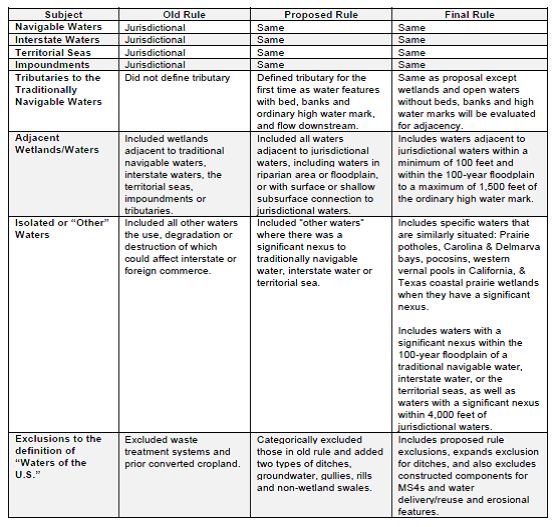
The regulated community, including industry and agricultural associations, have concluded that the Rule will substantially increase the geographic reach of CWA jurisdiction. Illustrations prepared by the Farm Bureau, showing how the new definitions will extend the geographic scope of CWA authority, are available here. For example, many small, isolated geographic areas with wetland characteristics that would have fallen outside CWA jurisdiction under existing Supreme Court precedent and prior agency interpretations will now be regulated or, at a minimum, require a case-by-case evaluation for jurisdiction (e.g., vernal pools, prairie potholes, etc.) that is both time-consuming and expensive.

Although EPA and the Corps argue that the Rule “does not interfere with or change private property rights, or address land use,” as a practical matter the Rule will require many property owners that were not previously regulated by the CWA to engage with the Corps to determine whether there are jurisdictional waters and wetlands on their property and, if so, to pursue permits prior to any development or other activities within the regulated area.

Expected consequences as a result the Rule include:
  • Expanded Jurisdiction and Burden on the Regulated Community. EPA and the Corps, via adoption of the Rule, seek to dramatically expand the geographic reach of federal jurisdiction under the CWA. As a result, many property owners will now be regulated by the CWA for the first time. Prior to development or intrusive activities in potentially regulated areas, those property owners will need to retain consultants to assess the extent of federal jurisdiction, potentially seek an approved jurisdictional determination from the Corps and/or a permit, and either mitigate potential impacts or alter development on, or use of their private property. For some property owners, activity that was previously lawful on their private property will now be subject to CWA jurisdiction. For example, existing mining (e.g., sand, gravel, etc.) in an area with prairie potholes or vernal pools will likely require a jurisdictional evaluation prior to continued operation.
  • Regulatory Confusion. In the short-term, there is likely to be substantial confusion among regulators, as they come up to speed with the requirements in the new Rule, and throughout the regulated community as the new Rule is implemented. This confusion may result in additional enforcement activity. There is also likely to be confusion about whether the new Rule will apply to pending permit applications and existing, unresolved enforcement actions.
  • Slower Permitting. Although EPA and the Corps claim that the Rule will reduce ambiguity, in the short term we expect confusion caused by the new definitions will further slow the permitting process for all. Additionally, because of the substantial increase in the geographic reach of CWA jurisdiction, an increase in permit applications (or requests for approved jurisdictional determinations) will likely tax Corps and EPA resources. Delay in issuing permits and approved jurisdictional determinations will result in substantial transaction costs and other economic damages to the regulated community.
  • Legal Challenges to Scope of the Rule. We expect legal challenges to the Rule, both in connection with the rulemaking itself, and as the Rule is applied on a case-by-case basis. It will likely take years for legal precedent to accumulate to the point where the full extent of CWA jurisdiction claimed by the Rule is clearly specified and understood.
  • Congressional Opposition. Republicans in Congress have already started efforts to overturn the Rule. On May 12, for example, the House, passed legislation (by a vote of 261-155) that would require EPA and the Corps to withdraw the Rule. The Senate is exploring similar legislation. Although the Obama Administration has already stated that President Obama would veto any such legislation, there is likely to be a continuing political show-down over the Rule through the 2016 election and beyond.
-- Tom Boer

For more information, contact Tom Boer at jtb@bcltlaw.com or (415) 228-5413.
Tuesday, April 7, 2015

California Issues Emergency Regulations Restricting Underground Injection in Connection with Oil and Gas Recovery

The California Department of Conservation (“Department”) proposes to adopt emergency regulations purported to bring California’s underground injection control program into compliance with the federal Safe Drinking Water Act (“Act”). These regulations will be submitted to the Office of Administrative Law on April 9, 2015, and are scheduled to go into effect on April 20, 2015. This is the next step in the systematic statewide review of oil and gas injection practices being conducted by the state Division of Oil, Gas, and Geothermal Resources (“DOGGR”) and the State Water Resources Control Board (“State Water Board”) at the behest of U.S. EPA.

Enacted in 1974, the Act requires that an underground source of drinking water (“USDW”) be protected from contamination by injection wells. In the early 1980s, through DOGGR, California applied for and received primacy to implement a Class II Underground Injection Control (“UIC”) program. The UIC Class II regulatory program extends to wells that inject fluid associated with oil and gas production.

On Thursday of last week, the Department made a finding of emergency stating that it had identified over 2,500 wells in California (including both enhanced oil recovery injection wells and disposal injection wells) that “may have been improperly approved for injection into non-exempt aquifers protected by the Act.” A corrective action plan formulated by U.S. EPA, DOGGR, and the State Water Board, calls for DOGGR to implement a compliance schedule for phasing out injections into USDWs, either by obtaining an aquifer exemption or by halting injection into the aquifer.

The following compliance deadlines have been established by U.S. EPA:
  • October 15, 2015 is the shut-in deadline for wells injecting into non-exempt, non-hydrocarbon-bearing aquifers with less than 3,000 mg/L total dissolved solids (“TDS”) that do not have an aquifer exemption;
  • December 31, 2016 is the shut-in deadline for wells injecting into 11 specific aquifers historically treated as exempt by U.S. EPA, unless U.S. EPA takes further action to affirm exemption of the pertinent aquifer(s) before that deadline; and
  • February 15, 2017 is the shut-in deadline for all wells injecting into non-exempt aquifers with less than 10,000 mg/L TDS that do not have an aquifer exemption.
The proposed regulations would establish a civil penalty of $25,000 per day for each well in which injection occurs beyond the compliance deadline.

U.S. EPA’s mandates are significant in part because U.S. EPA may withdraw California’s primacy authorization under the Act if the State fails to comply with the terms of its Primacy Agreement and fails to take additional corrective actions.

- Kathryn Oehlschlager, Tom Boer, and Sherry Jackman

For more information, contact Kathryn Oehlschlager at klo@bcltlaw.com or (415) 228-5458, Tom Boer at jtb@bcltlaw.com or (415) 228-5413, or Sherry Jackman at sej@bcltlaw.com or (415) 228-5412.

Wednesday, March 18, 2015

DTSC Invites Public Comments on Proposed Supplemental Environmental Projects Policy

This month, the California Department of Toxic Substances Control (“DTSC”) issued a Public Notice proposing a Supplemental Environmental Projects (“SEP”) Policy (“Policy”). DTSC is seeking public comment on the Policy through April 16, 2015. The final Policy will provide an option to perform a SEP in exchange for a reduction in the cash penalty paid to DTSC in response to environmental enforcement actions and, therefore, will be relevant to any party negotiating a settlement with DTSC in the future.

The Policy proposes an official framework for the incorporation of SEPs into administrative and civil settlements with DTSC. The Policy’s proposed SEP definition is virtually identical to the SEP definition contained within the U.S. EPA’s Supplemental Environmental Projects Policy issued in 1998 (“EPA Policy”), which is referenced by DTSC as one of several foundational documents supporting the development of the Policy. The DTSC Policy, however, departs from the EPA Policy in several key respects, including the maximum penalty deduction credited to a defendant for agreeing to implement a SEP (as described in greater detail below).

The Policy provides the following definitions and associated key terms:
  • A “Supplemental Environmental Project” means an environmentally beneficial project that a defendant/respondent agrees to undertake or fund in settlement of an enforcement action, which the defendant/respondent is not otherwise legally required to perform. . . .
  • Environmentally beneficial” means a SEP must improve, protect, or reduce risks to public health or the environment at large. While in some cases a SEP may provide an alleged defendant/respondent with certain benefits, there must be no doubt that the project primarily benefits public health and/or the environment.
  • In settlement of an enforcement action” means: (1) DTSC has the opportunity to shape the scope of the project before it is implemented; and (2) the project is not commenced until after DTSC has identified a violation(s), e.g., issued a notice of violation, administrative order, or complaint. Expenditures for a SEP may, in effect, be substituted in part for a penalty as part of a settlement.
  • Not otherwise legally required to perform” means the SEP is not required by any federal, state, or local law or regulation or previous administrative or judicial order.
In the Policy, DTSC proposes guidance on the prioritization and categorization of SEPs:
  • Environmental justice is listed as a priority under the Policy. DTSC will prioritize the use of SEPs that benefit a community in which potential or actual harm from the alleged violations may have occurred. A community identified within the top 25% highest scoring census tracts of the most current version of CalEnviroScreen will receive the highest priority for SEPs.
  • Categories of acceptable SEPs include those relating to Public Health, Pollution Prevention, Pollution or Hazardous Waste Reduction, Environmental Restoration and Protection, Assessment and Audits, Environmental Compliance Promotion, Enforcement Enhancement, and Emergency Planning and Preparedness. Seven of these eight categories are identical to those contained within the federal EPA Policy; the sole departure is the inclusion of the “Enforcement Enhancement” category which DTSC defines as a SEP providing for the training of enforcement and compliance staff or paying for government acquisition of surveillance equipment. Under the Policy, DTSC will also consider SEPs that do not fit into the listed categories, provided they are consistent with all other provisions of the Policy.
  • Examples of unacceptable SEPs provided by DTSC include general educational or public environmental awareness projects that lack a nexus to the community or environmental impacts identified through the enforcement action, and projects which, though beneficial to a community, are unrelated to environmental protection.
Provided that a proposed SEP is approved by DTSC in conjunction with a settlement, the Policy states that DTSC will allow a reduction of up to 25% of the monetary settlement that would otherwise be paid as a penalty (exclusive of any enforcement costs recovered by DTSC). In contrast, the existing EPA Policy permits a potentially greater credit for the performance of a SEP, as long as a defendant satisfies the minimum penalty requirement (the minimum penalty under the EPA Policy must be the greater of (i) the economic benefit of noncompliance plus 10% of the gravity calculation, or (ii) 25% of the gravity calculation). To illustrate, if the initial penalty for settlement of an alleged violation is $100,000, but the settling party wished to achieve the maximum deduction available via performance of a SEP:
  • Under DTSC’s Policy, an acceptable SEP could provide a credit of up $25,000. In other words, a defendant could perform a SEP valued at up to $25,000 and pay a penalty to DTSC of $75,000. Thus, the total cost to the defendant for the SEP and the penalty would be $100,000.
  • Under the EPA Policy a greater SEP credit would likely be available, but the calculation is more complex and depends upon the relative economic benefit and gravity components of the assessed penalty and an evaluation of what percent of the SEP cost EPA will allow to be credited to a settling party. Assuming that the penalty consisted of a $25,000 economic benefit component and a $75,000 gravity component, the “minimum penalty” that must be paid to EPA would be $32,500. Thus, performance of a SEP could provide a credit offsetting the penalty paid to EPA in an amount up to $67,500 ($100,000 minus $32,500). Under the EPA Policy, however, EPA does not provide dollar-for-dollar credit for the cost of a SEP and instead allows a credit for a maximum of 80% of the cost of a SEP. As a result, the actual penalty paid to EPA would have to be in excess of $32,500 under this example (if, e.g., the settling party spent only $67,500 on the SEP), or the cost of the SEP would have to be in excess of $67,500 to provide the maximum available reduction in the penalty as a result of the performance of a SEP.
In the Policy, DTSC provides guidance on how SEPs must be implemented following approval of a settlement:
  • SEPs may be performed in three different ways: (1) directly by the defendant; (2) by a payment made by the defendant directly to CalEPA’s 14300 Environmental Enforcement and Training Account Program or CalEPA’s Environmental Justice Small Grant Program; and/or (3) by a third party using funds provided by the defendant/respondent.  Under the third option, DTSC may approve a non-governmental organization or nonprofit to oversee the completion of the SEP provided that, among other things, administrative expenses do not exceed 10% of the cost of the SEP.
  • The Policy provides that orders or judgments authorizing a SEP must require periodic reporting to DTSC, include a schedule for project implementation, contain or reference performance standards, and provide for payment of DTSC oversight costs.
  • The Policy contains a number of provisions relating to project payment, tracking, reporting and oversight. The provisions require submission of a SEP completion report to DTSC declaring the completion of the SEP and addressing how the expected outcome or performance standards of the project were met.
DTSC has invited the public to submit comments on the draft Policy through April 16, 2015. To encourage public participation, DTSC will be hosting a series of public workshops on March 18, 19, and 26 at locations throughout California.

--Tom Boer and Sherry Jackman

For more information, contact Tom Boer at (415) 228-5413 or jtb@bcltlaw.com, or Sherry Jackman at (415) 228-5412 or sej@bcltlaw.com.

Tuesday, December 9, 2014

US EPA Appears to Put TSCA Fracking Rule On Ice

A November 2014 report on anticipated regulatory actions by the US Environmental Protection Agency (“EPA”) indicates that development of a potential rule requiring manufacturers and processors of fracking chemicals to report chemical data, including health and safety studies, is a low priority and is unlikely to be pursued by EPA in the short-term.

In 2011, a coalition of environmental groups petitioned EPA to promulgate a rule specific to fracking chemicals and mixtures used in oil and gas exploration and production. The petition asked the agency to regulate fracking chemicals pursuant to its authority under the Toxic Substances Control Act (“TSCA”).

More specifically, the petition asked EPA to adopt a rule:
  • Requiring, pursuant to Section 4 of TSCA, that manufacturers and distributors of fracking chemicals conduct toxicity testing and make those testing results available to the public; and
  • Imposing, pursuant to Section 8 of TSCA, recordkeeping and reporting requirements for fracking chemicals used in oil and gas exploration and production.
Shortly after receiving the petition, EPA concluded that the petitioners failed to “set forth sufficient facts” to support the request for a rule pursuant to Section 4 of TSCA. EPA further explained the basis for rejecting the request for a Section 4 rulemaking in a July 11, 2013, Federal Register notice (78 FR 41,768). In the same notice, EPA announced its intent to proceed with the publication of an Advance Notice of Proposed Rulemaking (“ANPR”) as a first step in evaluating the petitioners’ request that EPA adopt recordkeeping and reporting requirements for fracking chemicals pursuant to EPA’s authority provided by Section 8 of TSCA.

EPA published its ANPR addressing the potential regulation of fracking chemicals in May 2014 (79 FR 28,664). According to EPA, the purpose of the ANPR was to “initiat[e] a public participation process to seek comment on the information that should be reported or disclosed for hydraulic fracturing chemical substances and mixtures and the mechanism for obtaining this information.” The public comment period for the ANPR was extended by EPA and closed in September of this year. Nearly 2,500 public comments on the ANPR were received by EPA and have been placed into the administrative record.

If EPA chooses to proceed with a rulemaking, the Agency’s next steps would entail: (i) reviewing the ANPR public comments; (ii) developing a specific proposed rule to address fracking chemicals pursuant to EPA’s authority under Section 8 of TSCA; and (iii) publishing the proposed rule in the Federal Register for public comment.

On November 21, 2014, EPA published its semi-annual Regulatory Plan, which highlights priority areas for regulatory development. The TSCA rulemaking for fracking chemicals was not included as a priority in the Regulatory Plan. EPA’s summary of the status of a potential rulemaking, instead, provides the following information:
  • EPA placed the potential rulemaking into its “long-term action” category. In submitting regulatory plans, agencies generally categorize actions into one of five stages: pre-rule, proposed rule, final rule, completed action, or long-term action. It is generally accepted that EPA lists rules in the long-term action category when it does not expect to take any significant steps to advance a potential rule over the next twelve months, and thus considers the rule to be a lower priority in the short-term.
  • EPA indicates that the “Next Action [is] Undetermined” for the potential rulemaking, states that no legal deadlines apply to a potential rulemaking, and provides no specific date for future agency action on a potential rule.
  • EPA classifies a potential rulemaking as “Other Significant,” which applies to those regulations that are considered by EPA to have a “substantial impact on the public interest,” but are not “Economically Significant,” i.e., do not have an annual effect of at least $100 million.
It appears unlikely, therefore, that EPA will publish a proposed rule to impose recordkeeping and reporting requirements for fracking on the oil and gas industry anytime in 2015. In the meantime, a number of states -- including, recently, California and Colorado -- have adopted recordkeeping, reporting, and/or public disclosures requirements related to fracking operations. For the time being, therefore, it appears that States, and not EPA, will take the lead in regulating chemical usage related to fracking operations.

Although EPA has put the brakes on proposing a TSCA rule applicable to fracking chemicals, EPA will continue to evaluate fracking. The Agency, for example, is proceeding with a comprehensive study originally announced in March 2010 that is intended to “better understand any potential impacts of hydraulic fracturing for oil and gas on drinking water resources.”  According to EPA, “work is underway” to prepare a draft report for public comment and peer review. Further information on the status of that study, which was requested by Congress via a fiscal year 2010 Appropriations Committee Conference Report, is available by clicking here.
 
--Tom Boer

For more information, contact Tom Boer at jtb@bcltlaw.com, or (415) 228-5413.

Tuesday, October 7, 2014

EPA Announces Final Rule Eliminating ASTM Phase I ESA Standard E1527-05 from CERCLA “All Appropriate Inquiries Rule”

On October 6, 2014, the EPA announced a final rule amending the “All Appropriate Inquiries Rule” [40 CFR Part 312] (“AAI Rule”) for conducting environmental site investigations of potentially contaminated property.

The final rule removes reference to the ASTM International 2005 standard – ASTM E1527-05 – as an acceptable standard for undertaking “all appropriate inquiries” necessary to qualify for certain liability protections under the Comprehensive Environmental Response, Compensation, and Liability Act (CERCLA), including the bona fide prospective purchaser defense and innocent landowner defense. In June of this year, EPA had announced its intention to eliminate the reference to the 2005 standard, which was replaced in 2013 by an updated standard, ASTM 1527-13, that contains new requirements.

The purpose of the final rule is to “reduce any confusion associated with the regulatory reference to a historical standard that is no longer recognized by its originating organization [ASTM International] as meeting its standards for good customary business practice.”

EPA also believes that its final rule will promote the use of the updated 2013 ASTM standard. As EPA notes, most environmental professionals are likely already using the updated standard, described as “a currently recognized industry consensus-based standard to conduct all appropriate inquiries as provided under CERCLA.”

The effective date for the new rule is October 6, 2015, “to provide parties with an adequate opportunity to complete AAI investigations that may be ongoing [under the 2005 standard] and to become familiar with the updated industry standard (ASTM E1527-13).”

For more information on the AAI Rule and the updated ASTM 1527-13 standard, see our prior blog post.

-- Don Sobelman and Nicole Martin

For more information, contact Don Sobelman at des@bcltlaw.com or (415) 228-5456, or Nicole Martin at nmm@bcltlaw.com or (415) 228-5435.

Tuesday, June 17, 2014

EPA Proposes Elimination of ASTM Phase I ESA Standard E1527-05 from CERCLA All Appropriate Inquiries Rule

The EPA has announced a proposal to amend the “All Appropriate Inquiries Rule” for conducting environmental site investigations of potentially contaminated property. The proposed amendment will eliminate ASTM E1527-05 (“Standard Practice for Environmental Site Assessments: Phase I Environmental Site Assessment Process”) as an acceptable standard for undertaking “all appropriate inquiries” necessary to qualify for certain liability protections under the Comprehensive Environmental Response, Compensation and Liability Act (CERCLA).

The All Appropriate Inquiries Rule, 40 CFR part 312 (“AAI Rule”), outlines environmental investigations and inquiries that prospective property purchasers must undertake to qualify for certain liability protections under CERCLA, including the bona fide prospective purchaser defense, contiguous property owner defense, and innocent landowner defense. The requirements also apply to recipients of certain EPA grant funds. In 2005, the AAI Rule recognized a standard published by ASTM International, ASTM E1527-05, as a standard that satisfies these requirements.

In December 2013, the EPA published a final rule that formally identified the recently published ASTM E1527-13 as another acceptable standard. ASTM E1527-13 updated ASTM E1527-05 by, among other things,
  • clarifying and redefining certain key terms, such as “recognized environmental conditions” (or “RECs”), “historical RECs,” and “controlled RECs,” 
  • explicitly recognizing that potential vapor migration and releases must be considered, and
  • providing additional guidance relating to regulatory agency file and records review.
When EPA formally incorporated the updated ASTM E1527-13 standard into the AAI Rule in December 2013, the agency stated that it “strongly encourages prospective purchasers of real property to use the updated ASTM E1527-13 standard when conducting all appropriate inquiries.” However, EPA chose not to eliminate reference to the 2005 standard altogether, at that time. 

By now removing reference to ASTM E1527-05 from the AAI Rule, EPA hopes to “reduce any confusion associated with the regulatory reference to a historical standard that is no longer recognized by its own promulgating organization as meeting its standards for good customary business practice,” and to “promote the use of the standard currently recognized by ASTM International . . . .”   

EPA is proposing that the effective date for removal of the reference to ASTM E1527-05 be one year following publication of the final rule, “to provide parties with an adequate opportunity to complete AAI investigations that may be ongoing and to become familiar with the updated industry standard (ASTM E1527-13).”

A separate ASTM standard identified in the AAI Rule for “Forestland or Rural Property” (ASTM E2247-08) is unaffected by today’s proposed rule.
 
--Don Sobelman and Nicole Martin

For more information, contact Donald Sobelman at (415) 228-5456, des@bcltlaw.com, or Nicole Martin at (415) 228-5435, nmm@bcltlaw.com.

Wednesday, June 11, 2014

Agencies Extend Comment Period for “Waters of the United States” Proposed Rule

Having received over 60,000 comments already, the U.S. Environmental Protection Agency and U.S. Army Corps of Engineers have extended the comment period for their proposed rule defining “waters of the United States.” The proposed rule would redefine what types of waters are subject to regulation under the Clean Water Act. The proposed rule was published in the Federal Register on April 21, 2014 and, as Barg Coffin attorneys predicted, has received a flood of interest. Stakeholders now have until October  20, 2014 to submit comments. 

-- Estie Kus

For more information, contact Estie Kus at (415) 228-5463 or emk@bcltlaw.com.

Monday, June 2, 2014

EPA Releases Proposed Rule for Reducing Power Plant CO2 Emissions

Earlier today, EPA released its much-anticipated proposal for reducing greenhouse gas emissions from existing fossil fuel-fired power plants.

In its proposed rule, EPA proposes “state-specific rate-based goals for carbon dioxide emissions from the power sector.” To achieve these goals, states implementing the program would be given flexibility to adopt a range of approaches, including caps on overall emissions (as in California’s cap and trade program) and other programs that would achieve greenhouse gas emissions reductions “outside the fence”—i.e., outside of the utility sector. 

EPA projects a reduction in annual carbon dioxide emissions in the range of 26 to 30 percent of 2005 levels by 2030 if the proposed rule is implemented. Although all fossil fuel-fired power plants would be affected by the draft rule, coal-fired plants would face the steepest reduction requirements.

As anticipated, environmental groups have generally reacted positively to EPA’s announcement, while the coal industry and lawmakers from West Virginia, North Dakota, and other coal producing states oppose the proposal. 

Comments on the proposed rule are due September 30. 

-- Chris Jensen

For more information, contact Chris Jensen at cdj@bcltlaw.com or (415) 228-5411.

Thursday, May 15, 2014

Environmental Groups Petition EPA to Regulate Air Emissions from Oil and Gas Production and Fracking in Urban Areas

On Tuesday, May 13, 2014, a coalition of environmental organizations led by EarthJustice submitted a Petition to the United States Environmental Protection Agency calling for the regulation of air emissions associated with oil and gas wells, particularly fracking, under the federal Clean Air Act. The environmental groups allege that toxic pollutants emitted by these operations present health risks and that such health risks are increasing as fracking operations move closer to urbanized communities.

Due to the alleged risk to public health, the environmental groups:
urgently request[] EPA to exercise its authority under the Clean Air Act to list oil and gas wells (and associated equipment) located in the appropriate geographical areas as area sources, and set limits on hazardous air pollutant emissions from oil and gas wells and associated equipment in accordance with 42 U.S.C. §§ 7412(c), (d), (k), and (n)(4)(B).
The Petition also argues that EPA “has a responsibility under the Clean Air Act to protect people from the toxic air emissions [from oil and gas operations] nationwide, and under section 112(n)(4)B) it must do so.”

The Petition requests that EPA take two specific actions pursuant to the Clean Air Act:
  1. Exercise its authority provided by the area source program of the Clean Air Act by listing oil and gas production wells (including fracking activities) as an area source. The Petition argues that the Clean Air allows regulation of “hazardous air pollutants from area sources [that] may individually, or in the aggregate, present significant risks to public health in urban areas,” that oil and gas activities can be properly classified as area sources, and that the Act provides authority to designate such area sources in metropolitan statistical areas (and/or consolidated metropolitan statistical areas) with a population in excess of one million; and
     
  2. Set emissions standards for oil and gas production wells (and associated equipment) within the newly listed area source category in accordance with 42 U.S.C. §§ 7412(c)(2), 7412(d)(2)-(3), and 7412(k), that would require implementation of the “maximum achievable” degree of emission reduction.
Under the Clean Air Act, EPA is required to respond to the Petition. Although the Petition seeks a response within 180 days, the Clean Air Act imposes no specific deadline for EPA action.

There will almost certainly be future litigation over the issues raised in the Petition. The environmental groups that filed the Petition may sue EPA if the petition is denied, or if the Agency fails to act in response to the Petition. Alternatively, if EPA moves forward with some type of regulation of oil and gas production and fracking under the Clean Air Act, litigation would likely be brought by either environmental groups (claiming that the regulations are inadequate to protect human health), industry groups (challenging the basis and scope of any regulation of these activities), or both.

A copy of the petition is available here.

-- Tom Boer

For more information, contact Tom Boer at jtb@bcltlaw.com, or (415) 228-5413.

Monday, May 12, 2014

D.C. Circuit Rejects Another Clean Air Act Challenge, Upholds Fine Particulate Standard

The D.C. Circuit added to federal air quality regulators’ winning streak on Friday, upholding a 2013 rule that revises air quality standards for fine particulate matter.

The rule lowers the National Ambient Air Quality Standard (NAAQS) for fine particulate matter from 15.0 µg/m3 to 12.0 µg/m3, and also tightens monitoring requirements for particulate air pollution. Writing for a unanimous court, Judge Kavanaugh cited the “great deference” given to EPA’s evaluation of “competing bodies of scientific research” in rejecting the National Association of Manufacturer’s challenge to the revised  standard. The court also upheld revisions to the NAAQS that eliminate the use of “spatial averaging” of monitoring data to demonstrate compliance with the standard and require additional monitoring locations near heavily traveled roads in large metropolitan areas, as well as rejecting several procedural challenges to the sufficiency of EPA’s notice of the proposed rule and its response to industry comments.

The court’s decision is the latest in a string of cases in the D.C. Circuit (previously discussed here and here) and Supreme Court (discussed here) upholding EPA Clean Air Act rules. The common theme running through the majority decisions in each of these cases is the court’s willingness to defer to EPA’s technical expertise in setting air quality and emissions standard under the Clean Air Act.  EPA has achieved these positive judicial outcomes notwithstanding criticism that EPA at times requests technical deference to mask imperfections in the rule making process and that EPA staff lacks adequate industry-specific experience to be entitled to such deference.

The biggest test of judicial deference to EPA expertise in the field of air quality regulation is still to come, when the Supreme Court issues its ruling on a challenge to EPA’s “tailoring rule” for the regulation of greenhouse gas emissions from power plants and large industrial facilities. As Morgan Gilhuly and I have previously discussed in our commentary on the Supreme Court’s EPA v. EME Homer City Generation decision, proponents of the federal regulation of greenhouse gases hope that that these recent decisions foreshadow the outcome of the tailoring rule case. A decision in that case, Utility Air Regulatory Group v. EPA, No. 12-1146, is anticipated before the end of the current term in June.

The challenge to the fine particulate NAAQS was brought in National Manufactures Association v. EPA, No. 13-1069.  The court’s opinion is available here

-- Chris Jensen

For more information, please contact Chris Jensen at cdj@bcltlaw.com or (415) 228-5411.

EPA Seeks Public Comment on the Potential Nationwide Regulation of Fracking Chemicals and Mixtures

On May 9, the Administrator of the United States Environmental Protection Agency (“EPA”) signed an advanced notice of proposed rulemaking (“ANPR”) seeking public input on whether the Agency should collect and publicly disclose information on hydraulic fracturing chemical substances and mixtures. The ANPR, titled Hydraulic Fracturing Chemicals and Mixtures; Advance Notice of Proposed Rulemaking [RIN 2070-AJ93; FRL-9909-13], will be published in the Federal Register shortly, and will provide 90 days for submission of public comments. 

EPA published the ANPR in response to an August 2011 citizen petition submitted under section 21 of the Toxic Substances Control Act (TSCA) by Earthjustice and a coalition of other environmental entities. 

The ANPR seeks input on a wide range of issues related to fracking chemicals and mixtures. Broadly summarized, EPA requests comment from the public and stakeholders on the following issues:
  • Whether EPA should collect information on fracking chemicals and mixtures;
  • If so, which legal mechanism(s) EPA should use to obtain such information from the regulated community and whether submission of the information would be mandatory or voluntary;
  • What companies or practices would be subject to reporting requirements or other regulation of fracking chemicals;
  • Information on best management practices for the generation, collection, reporting and/or disclosure of public health and environmental information, potentially including health and safety studies, from or by companies that manufacture, process, or use chemical substances or mixtures in hydraulic fracturing;
  • What practices or operations can be implemented and verified to achieve protection of public health and the environment associated with fracking chemicals and mixtures;
  • Whether voluntary third-party certification, and incentives for disclosure, could be valuable tools for improving chemical safety related to fracking;
  • Whether incentives and recognition programs could be used to support the development and use of safer chemicals in hydraulic fracturing; and
  • Identification of options to minimize reporting burdens and costs, avoid duplication of efforts, and maximize transparency and public understanding associated with fracking chemicals.
EPA will use the information collected during the public comment period to decide whether to proceed with the development of a proposed rule to regulate fracking chemicals and mixtures. If EPA proceeds with such a rulemaking, EPA will be required to publish a detailed copy of the proposed rule, including the justification and basis for the rulemaking, and seek comment from the public and stakeholders prior to adopting any final, enforceable regulation. 

The ANPR is particularly relevant to companies that manufacture, import, process, or distribute any chemical substances or mixtures used in any type of hydraulic fracturing. EPA indicates in the ANPR that future regulation could extend to chemical manufacturers, chemical suppliers who engage in processing, service providers mixing chemicals on site to create the hydraulic fracturing fluids, and service providers responsible for injecting the hydraulic fracturing fluid into the well to fracture a formation. This would likely include, at a minimum, businesses falling under the North American Industry Classification System codes 2111 (oil and gas extraction) or 2131 (support activities for mining). 
 
As part of its regulatory process, EPA is specifically considering the legal authority under which it would regulate fracking chemicals. EPA is evaluating whether regulation would be mandatory, pursuant to the Agency’s authorities under TSCA section 8(a) and/or section 8(d), or voluntary pursuant to the Pollution Prevention Act, 42 U.S.C. 13101, or a combination of both. If EPA proceeds to issue a rule under its TSCA authorities, the regulated community may be legally obligated to publicly report the “identity, quantities, types and circumstances of uses of chemical substances and mixtures used in hydraulic fracturing” and/or to conduct and disclose health and safety studies on the use of such chemicals.

The draft of the ANPR submitted to the Federal Register for publication is available on EPA’s website by clicking here
 
 
For more information, please contact Tom Boer at jtb@bcltlaw.com or (415) 228-5413.
 

Tuesday, April 29, 2014

Supreme Court Upholds EPA Interstate Air Pollution Regulations

The Supreme Court has upheld EPA regulations requiring reductions in SO2, NOx, and fine particle emissions in 28 states stretching from Texas to New York.

The regulations, known as the “Cross-State Air Pollution Rule” or “Transport Rule,” are intended to reduce interstate transport of air pollutants, and were enacted under the “Good Neighbor Provision” of the Clean Air Act, which requires states implementing federal Clean Air Act requirements to enact measures to avoid contributing “significantly” to nonattainment of air quality standards in other states. EPA adopted Federal Implementation Plans (FIPs) to meet the Good Neighbor Provision’s requirements after it concluded that the measures adopted  in the 28 State Implementation Plans (SIPs) at issue were inadequate.

The majority opinion, authored by Justice Ginsburg, concludes that EPA acted within its discretion in adopting a federal rule for cross-border pollution, and reverses a D.C. Circuit decision vacating the rule. Citing the plain meaning of the Clean Air Act, the Court rejects the argument that EPA was required to provide the states with an opportunity to revise their SIPs before adopting federal regulations. The Court also upholds EPA’s decision to take cost into account in allocating emissions reductions among upwind states. The majority opinion was authored by Justice Ginsburg and joined by Justices Roberts, Kennedy, Breyer, Sotomayor and Kagan. Justice Alito took no part in the consideration of the case. 

In his dissent, Justice Scalia (joined by Justice Thomas) argues that EPA abused its discretion by failing to give states an opportunity to modify their SIPs to meet the requirements of the Good Neighbor Provision before issuing federal implementation plans, and also took issue with EPA’s consideration of cost in setting emissions limits for upwind states, which he argues is prohibited by the plain language of the statute.

The lead case is EPA v. EME Homer City Generation, L.P., No. 12-1182.

-- Chris Jensen and Morgan Gilhuly

For more information, please contact Chris Jensen at cdj@bcltlaw.com, (415) 228-5411, or Morgan Gilhuly at rmg@bcltlaw.com, (415) 228-5460.

Friday, April 18, 2014

D.C. Circuit Upholds Most of Portland Cement MACT, Vacates “Unavoidable Malfunction” Defense

In a unanimous ruling issued earlier today, the D.C. Circuit largely upheld EPA regulations governing emissions of toxic air pollutants from Portland cement plants, while vacating a provision that created an affirmative defense for “unavoidable” equipment malfunctions.

The regulations, issued in February 2013, set limits for emissions of particulate matter, mercury, hydrochloric acid, and hydrocarbons from Portland cement manufacturing facilities. 

In rejecting several arguments advanced by environmental organizations challenging the regulations, the court held that EPA reasonably interpreted the Clean Air Act to allow the Agency to consider compliance costs in setting “beyond-the-floor” MACT limits for toxic air pollutants.  The court also rejected the argument that Section 112(d)(7) of the Clean Air Act should be interpreted as an anti-backsliding provision and held that EPA acted reasonably in extending the compliance date for all pollutants covered by the regulations when it revised the standard for particulate matter in the 2013 rule.

However, the court concluded that the creation of an affirmative defense for “unavoidable” equipment malfunctions exceeded EPA’s statutory authority.

The lead case is Natural Resources Defense Counsel v. EPA, Case No. 10-1371.

--Chris Jensen

For more information, contact Chris Jensen at cdj@bcltlaw.com, or (415) 228-5411.

Wednesday, April 16, 2014

D.C. Circuit Upholds Power Plant Mercury and Air Toxics Standards

The D.C. Circuit has upheld a 2012 EPA rule limiting air toxics emissions from coal- and oil-fired power plants.  The rule, commonly known as the Mercury and Air Toxics Standards, or “MATS,” requires new and existing coal- and oil-fired power plants to reduce emissions of mercury, arsenic, chromium, and other toxic air pollutants.

In a 2-1 decision, the D.C. Circuit rejected a variety of challenges from industry and environmental groups, including a challenge to EPA’s conclusion that it was not required to consider costs in determining whether regulation of electric utilities is “appropriate and necessary” under Clean Air Act § 112(n)(1)(A).  While acknowledging that cost of compliance plays an explicit role in setting “beyond-the-floor” MACT standards and indirectly influences the determination of MACT floors, the majority deferred to the EPA’s determination that it is reasonable to make the initial decision to list the utilities as sources of hazardous air pollutants without taking cost into consideration.

In his dissenting opinion, Judge Kavanaugh argued that the term “appropriate” necessarily implied that costs should be taken into account in making the listing decision, citing EPA’s own regulatory impact analysis, which estimated the cost of implementing the rule at $9.6 billion.

The lead case is White Stallion Energy Center, LLC v. U.S. Environmental Protection Agency, D.C. Circuit Case No. 12-1100.

-- Chris Jensen

For more information, please contact Chris Jensen at cdj@bcltlaw.com or (415) 228-5411.

Thursday, January 9, 2014

EPA Calls for New “Completion Strategies” at Contaminated Groundwater Sites

In October 2013, the U.S. Environmental Protection Agency issued its draft “Groundwater Remedy Completion Strategy – Moving Forward with Completion in Mind,” which would establish a recommended strategy for an adaptive management-style approach to managing contaminated groundwater sites.  The strategy calls for rigorous data assessment of the performance of groundwater cleanup actions to achieve remedial action objectives (RAOs), and clarifies that RAOs and cleanup goals should be reevaluated if impediments prevent achieving those objectives. 

Buried in this regulatory jargon is one significant impact of the Completion Strategy – this document confirms EPA’s recognition that some groundwater sites present problems so intractable that RAOs and cleanup levels are not likely to be achieved in any reasonable timeframe. 

Although EPA clarifies that the Completion Strategy relies on–but does not alter–existing law and guidance, the document recommends that a remedy completion strategy be completed for all sites with groundwater remedies.  A completion strategy is “a recommended site-specific course of action(s) and decision making process(es) to achieve groundwater RAOs and associated cleanup levels using an updated conceptual site model, performance metrics and data derived from site-specific remedy evaluations.” 

The Completion Strategy lays out an adaptive management-style approach to evaluating remedy performance that proceeds through the following steps:
  • Understand site conditions, including timeframe estimated to achieve cleanup;
  • Design site-specific remedy evaluations, including endogenous and exogenous factors affecting remedy achievement;
  • Develop performance metrics–such as remedy operation metrics, progress metrics, and attainment metrics–and collect monitoring data;
  • Conduct remedy evaluations, including whether and when the remedy will achieve RAOs and cleanup levels; and
  • Make management decisions that feed these data points back into remedy design, potentially through an Explanation of Significant Differences (ESD) or a Record of Decision (ROD) Amendment.
The Completion Strategy’s data-centric approach reflects a current vogue in performance-based systems in environmental regulation.  By relying on augmented data feedback, the use of completion strategies may lead to more honest and sober reflection on whether remedial action objectives can be achieved for sites with complex groundwater contamination.  As a result, Superfund sites with intractable groundwater contamination problems may begin to find EPA to be more receptive to reevaluating RAOs based on intractable obstacles to remedy completion.

The comment period closed on December 20, 2013, and a final draft is expected in early 2014.  The draft Completion Strategy, supporting fact sheet, letter to “interested parties,” and a frequently asked questions document are all available here

--Dave Metres

For additional information, Dave Metres can be reached at dmm@bcltlaw.com or (415) 228-5488.

Wednesday, November 13, 2013

Agencies Send OMB Draft Regulations Defining Clean Water Act Jurisdiction

After years of starts and stops, the U.S. Environmental Protection Agency and U.S. Army Corps of Engineers have drafted a proposed regulation that will significantly affect which waters are subject to regulation under the Clean Water Act. 

Following 2001 and 2006 U.S. Supreme Court rulings addressing which “waters of the United States” are subject to Clean Water Act jurisdiction, EPA, the Corps, federal courts across the country, and the regulated community have all struggled to interpret the Supreme Court’s rulings.  Those rulings, Solid Waste Agency of Northern Cook County (SWANCC) v. U.S. Army Corps of Engineers, 531 U.S. 159 (2001), and Rapanos v. United States, 547 U.S. 715 (2006), offered no clear guidance.  Indeed, Justice Kennedy’s lone concurrence in the Rapanos plurality opinion stands as the guiding principle in determining what defines a “water of the United States.”

Justice Kennedy’s view that waters with a “significant nexus” to more traditionally jurisdictional waters may be regulated provides the basis of EPA’s and the Corps’ proposed regulation.  Among other things, the regulation would, for the first time, define “significant nexus.”  That term would be defined as “a more than speculative or insubstantial effect that a water, including wetlands, either alone or in combination with other similarly situated waters in the region . . . has on the chemical, physical or biological integrity” of more traditionally jurisdictional waters as defined in the regulation.  The proposal would also define “tributary” such that any defined tributary would have the significant nexus necessary to bring it within the scope of the Clean Water Act.

The agencies have submitted a draft of the proposed regulation to the Office of Management Budget.  When published in the Federal Register, it will undoubtedly generate thousands of comments.  It is far too early to speculate as to whether the final regulation will look like the proposed regulation, when a final regulation may be issued, and, in the face of almost certain litigation once the rule is final, when the regulations may actually be implemented. 

-- Josh Bloom

For more information, please contact Josh Bloom at (415) 228-5406 or jab@bcltlaw.com.

Monday, September 9, 2013

Third Circuit Holds That Settlement With a State Agency Is Sufficient to Give Rise to CERCLA 113(f)(3)(B) Contribution Claim

Since the Supreme Court’s decisions in Cooper Industries, Inc. v. Aviall Services, Inc., 543 U.S. 157 (2004) and United States v. Atlantic Research Corp., 551 U.S. 128 (2007), there has been continuing uncertainty about whether a CERCLA potentially responsible party (“PRP”) can bring a cause of action for contribution against other PRPs under CERCLA §113(f) where the PRP has settled with a state agency under state law, but has not resolved its liability with the U.S. EPA or a state agency via an “administrative or judicially approved settlement” under CERCLA. 

This issue, which Cooper Industries and Atlantic Research left undecided, is of importance to any PRP that has resolved its liability under state environmental laws without settling CERCLA claims and then seeks contribution for response costs.

In Trinity Industries, Inc. v. Chicago Bridge & Iron Co., 2013 WL 4418534 (3d Cir. Aug. 20, 2013), the Third Circuit  allowed such a contribution action to proceed, holding that CERCLA Section 113(f)(3)(B) “requires only the existence of a settlement resolving liability to the United States or a state ‘for some or all of a response action’” to support a PRP’s contribution claim.  Id. at *3-5.  The Third Circuit’s decision provides further insight into this important issue, but signals a circuit split that may require further clarification from the Supreme Court.

Trinity Industries, Inc. and Trinity Industries Railcar Corporation (“Trinity”) entered into a consent order with the Commonwealth of Pennsylvania naming Trinity as a “responsible person” for the release of hazardous substances at a site that it owned and had for some period used for manufacturing railcars.  The consent order required Trinity to undertake remediation of the site under the supervision of the Pennsylvania Department of Environmental Protection.  The consent order was entered under state environmental laws and did not explicitly resolve Trinity’s liability under CERCLA.  Trinity subsequently filed a contribution claim under CERCLA § 113(f)(3)(B) against a former owner of the site for a share of the remediation costs.

Persuaded by arguments of both Trinity and the United States, which filed an amicus brief in support of Trinity’s position, the court of appeals agreed that the statutory language of CERCLA § 113(f)(3)(B) does not require resolution of CERCLA liability in order to pursue a Section 113(f)(3)(B) contribution claim.  Rather, it only requires the existence of a settlement resolving liability to the United States or a state “for some or all of a response action.”  “Section 113(f)(3)(B) does not state that the ‘response action’ in question must have been initiated pursuant to CERCLA – a requirement that might easily have been written into the provision.”  Trinity Industries, 2013 WL 4418534 at *4.  The court also noted that because remediation standards established under state law were considered “applicable, relevant and appropriate” to satisfy requirements under CERCLA and that compliance with those state remediation standards relieved a party from CERCLA liability, the consent order at issue had eliminated the risk of future CERCLA enforcement actions by the government.  Id. at *5.

The Third Circuit’s decision in Trinity Industries conflicts with the Second Circuit’s holding that CERCLA § 113(f)(3)(B) only allows for contribution claims where a PRP’s liability under CERCLA has been resolved.  See, e.g., Consol. Edison Co. of N.Y., Inc. v. UGI Utils., Inc., 423 F.3d 90, 95 (2d Cir. 2005); W.R. Grace & Co. v. Zotos Int’l, Inc., 559 F.3d 85, 91 (2d Cir. 2009).  In declining to follow the Second Circuit, the Trinity Industries court notes that the Second Circuit’s Consolidated Edison decision relied on the legislative history of CERCLA § 113(f)(1) rather than Section 113(f)(3)(B).  The Third Circuit’s decision instead relied on the plain language of Section 113(f)(3)(B), and relevant legislative history, as well as Third Circuit precedent that declined to impose a requirement that a government agency specifically invoke CERCLA in its oversight activities as a condition precedent to bringing a CERCLA cost recovery action.  Trinity Indus., 2013 WL 4418534 at *4-5 (citing United States v. Rohm & Haas Co., 2 F.3d 1265 (3d Cir. 1993)). 

-- Tom Boer and Nicole Martin

For more information, please contact Tom Boer at (415) 228-5413, jtb@bcltlaw.com, or Nicole Martin at (415) 228-5435, nmm@bcltlaw.com.